
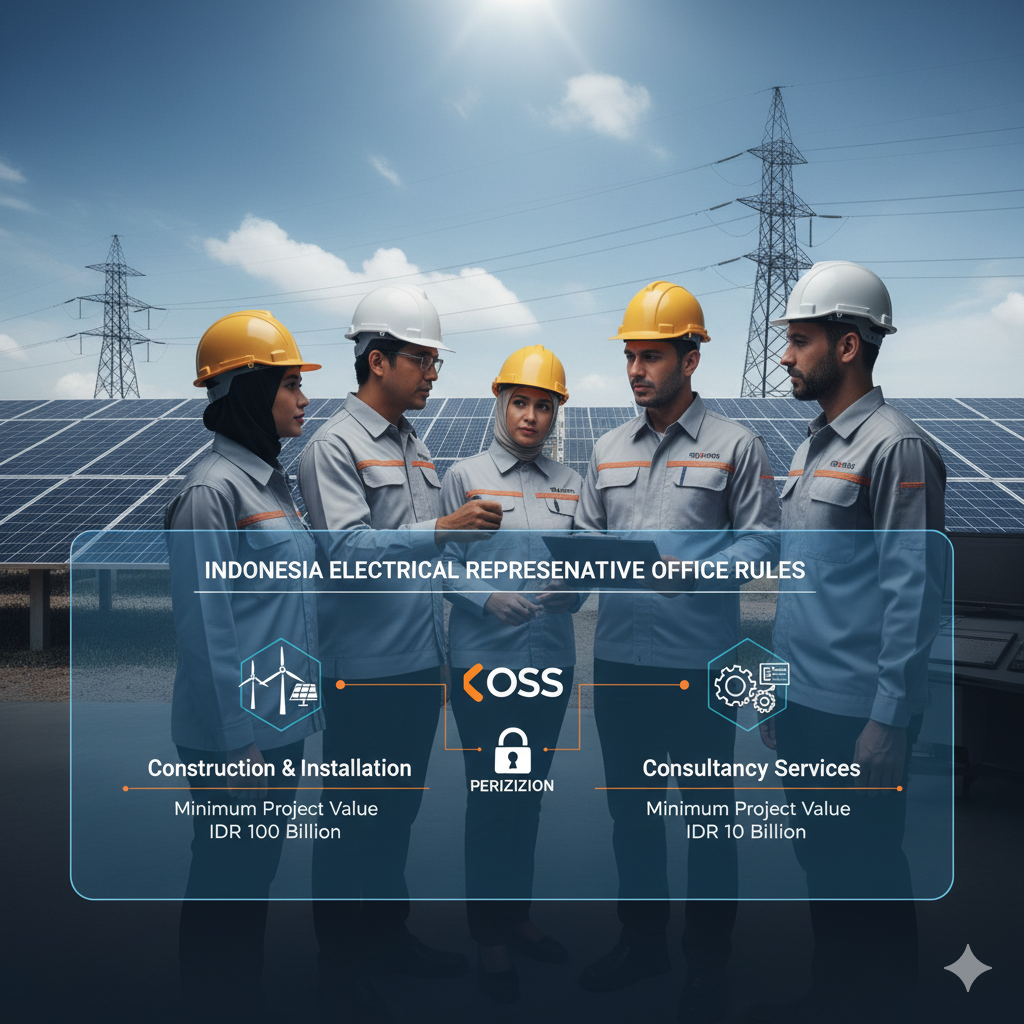

Indonesia Electrical Representative Office Rules Overview
The Indonesia electrical representative office framework allows foreign electrical power supporting services companies to establish a presence in Indonesia and conduct profit-generating activities under strict regulatory guidelines. This type of representative office is distinct from general KPPA or KP3A structures because it is permitted to undertake specific high-value activities related to electrical power plant consultation, installation, and maintenance. To operate legally, a foreign company must obtain a Business Entity Certification and an Electrical Power Supporting Services Business License before commencing any commercial activity.
This licensing requirement ensures that only qualified international companies with strong technical expertise may participate in Indonesia’s electrical infrastructure sector. The representative office may engage exclusively in high-cost projects, reflecting the government’s intention to protect national infrastructure integrity while opening opportunities for foreign specialists to contribute to large-scale energy developments.
Scope of Permitted Electrical Power Activities
Foreign electrical supporting services representative offices may participate in a narrow but commercially significant range of activities. These include:
- Consulting on electrical power plant design and feasibility
- Construction and installation of electrical power systems
- Maintenance and overhaul of electrical power plants
- Engineering and technical supporting services for high-value electrical projects
However, the permissible activities are subject to minimum project value thresholds designed to ensure that foreign participation is limited to large-scale undertakings requiring advanced expertise.
Under Indonesian regulations:
a. Construction and installation activities
A foreign electrical representative office may only perform construction and installation of electrical power plants where the minimum project value is IDR 100 billion.
b. Consultancy services for installation or maintenance
Consultancy activities for installation or maintenance of electrical power plants must also meet a minimum project value of IDR 10 billion.
These thresholds prevent foreign representative offices from entering smaller domestic markets while ensuring that foreign expertise is directed toward strategic, high-impact electrical projects.
Regulatory Compliance and Licensing Obligations
Foreign companies must comply with both national construction service regulations and electrical power sector laws overseen by the Ministry of Energy and Mineral Resources. Before a representative office may begin operating, it must obtain:
- Business Entity Certification (SBU)
- Electrical Power Supporting Services Business License (IUJKS Tenaga Listrik)
- Registration through the Online Single Submission (OSS) system
These requirements are intended to promote transparency, ensure quality assurance, and maintain safety standards in high-risk electrical environments. Non-compliance may result in license suspension, termination of project eligibility, or administrative sanctions.
Representative offices must also maintain clear documentation of their project portfolios, financial capacity, technical personnel, and safety management procedures. These compliance obligations ensure that foreign companies contribute responsibly to Indonesia’s growing electrical infrastructure demands.
Role in Indonesia’s Energy and Infrastructure Development
Indonesia’s expanding renewable energy and electrical grid modernization programs create substantial demand for high-tech expertise. Foreign electrical power supporting service companies can play a critical role in accelerating major projects such as power plant upgrades, transmission network expansion, renewable energy integration, and electrical system maintenance across industrial zones.
By allowing highly specialized foreign companies to participate under regulated conditions, Indonesia aims to enhance technology transfer, improve grid reliability, and strengthen national infrastructure resilience. These representative offices complement domestic contractors while filling capability gaps in advanced engineering and high-value electrical development.
Conclusion
Through its targeted licensing structure and strict project-value criteria, the Indonesia electrical representative office framework supports foreign participation in high-impact electrical power projects while safeguarding national infrastructure standards.